摘要
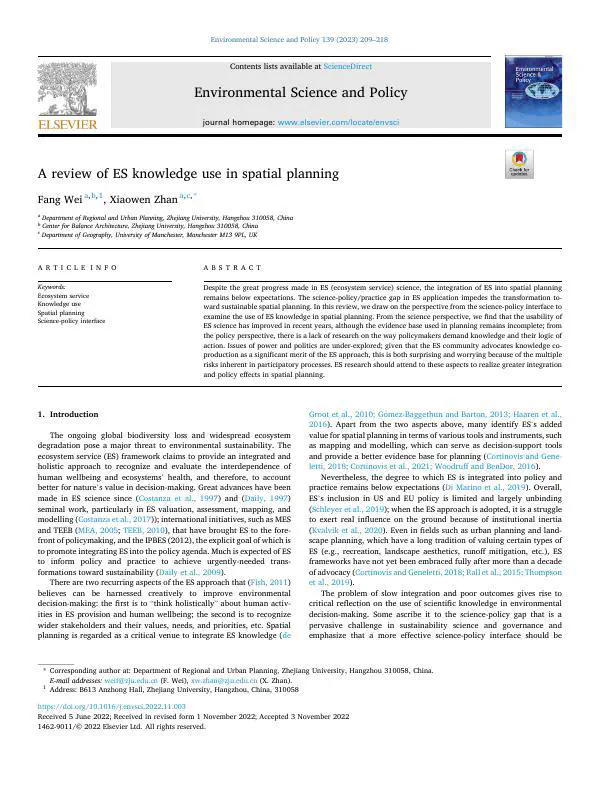
Despite significant advancements in ecosystem service (ES) science, its integration into spatial planning remains suboptimal, highlighting a science-policy/practice gap. This review examines ES knowledge use in spatial planning from the science-policy interface perspective. From the science side, while ES science’s usability has improved, the evidence base used in planning is often incomplete. From the policy side, research on how policymakers demand knowledge and their decision-making logic is lacking. Issues of power and politics, crucial for participatory processes and knowledge co-production, are underexplored. The review identifies that ES research needs to address these aspects to achieve greater integration and policy impact in spatial planning. Current ES knowledge use in spatial planning is dominated by conceptual and instrumental modes, with strategic use being rare. Barriers to integration include a lack of guidance, data, and institutional inertia. Future research should focus on understanding policymakers’ needs and institutional dynamics to foster better ES integration.
摘要
尽管生态系统服务(ES)科学取得了显著进展,但其在空间规划中的整合仍不尽如人意,这凸显了科学-政策/实践之间的差距。本综述从科学-政策界面视角审视了ES知识在空间规划中的应用。从科学层面来看,ES科学的可用性有所提高,但规划中使用的证据基础往往不完整。从政策层面来看,关于政策制定者如何需求知识及其决策逻辑的研究尚显不足。权力与政治问题,对于参与式过程和知识共生产至关重要,但被认为研究不足。本综述认为,ES研究需要关注这些方面,以实现ES在空间规划中的更大整合和政策效应。目前ES知识在空间规划中的应用主要以概念性和工具性使用为主,策略性使用较为少见。整合的障碍包括缺乏指导、数据不足和制度惯性。未来的研究应侧重于理解政策制定者的需求和制度动态,以促进ES的更好整合。
Abstract
Despite significant advancements in ecosystem service (ES) science, its integration into spatial planning remains suboptimal, highlighting a science-policy/practice gap. This review examines ES knowledge use in spatial planning from the science-policy interface perspective. From the science side, while ES science’s usability has improved, the evidence base used in planning is often incomplete. From the policy side, research on how policymakers demand knowledge and their decision-making logic is lacking. Issues of power and politics, crucial for participatory processes and knowledge co-production, are underexplored. The review identifies that ES research needs to address these aspects to achieve greater integration and policy impact in spatial planning. Current ES knowledge use in spatial planning is dominated by conceptual and instrumental modes, with strategic use being rare. Barriers to integration include a lack of guidance, data, and institutional inertia. Future research should focus on understanding policymakers’ needs and institutional dynamics to foster better ES integration.
引用格式
@article{2023_esp_es_spatial_planning,
  title={A review of ES knowledge use in spatial planning},
  author={蔚芳 and Xiaowen Zhan},
  journal={Environmental Science and Policy},
  year={2023},
  doi={https://doi.org/10.1016/j.envsci.2022.11.003}
}

蔚芳
浙江大学副教授
现任浙江大学建工学院副教授。先后于同济大学获得城市规划学士与硕士学位,美国弗吉尼亚理工大学获得城市管理与规划博士学位。致力于空间规划与人工智能,气候变化与空间优化等方面的研究。主讲课程包括《国土空间规划理论与方法》、《城市经济学》等。已发表中英文书章及学术论文30余篇,其中学术专著7部,研究成果发表于《Landscape and Urban Planning》《Environment and Planning A》《城市规划》等国内外知名SCI/SSCI/EI期刊。主持国家自然科学基金、浙江省自然科学基金等多项科研项目,以及数十项城乡规划与设计实践项目;同时主持包括浙江大学慕课(MOOC)课程在内的十余项教学改革项目。曾获金钥匙国际荣誉协会终身荣誉会员等多项国际学术荣誉;以及全国城乡建设优秀勘察设计奖、建设部城乡建设优秀勘察设计项目、浙江省及杭州市等优秀城乡规划设计奖、我最喜爱的老师等多项荣誉与奖项。现为多个国际学术组织的会员或终身荣誉会员,担任十余种国际学术期刊的审稿人;并担任包括国家自然科学基金、浙江省自然科学基金等在内的诸多基金项目评审专家。