摘要
Rapid urbanization has changed people’s traditional living habits. Non-communicable diseases (NCDs) attributable to lack of physical activity (PA) threaten public health. Scientific selection of the types and amount of PA are important to reduce NCDs’ effects. Considerable evidence has shown the association between PA and the built environment according to the social ecology model. Urban green spaces (UGS) and recreational infrastructure (RI) are important for PA, and provide residents not only pleasant outdoor exercise spaces, but support a variety of medium and vigorous intensity physical activities (MVPA). This study defines UGS and RI jointly as PA spaces that allow residents to engage in recreational MVPA, including parks, forests, sports venues, and community PA facilities. These spaces’ supply-demand balance (SDB) influences the level of PA directly. Nevertheless, previous studies have seldom addressed ways to arrange the UGS and RI as an integrated system to explore the SDB and ways to identify the effect of UGS and RI’s different SDB on PA. Therefore, this study’s goal is to explore the features and differences in PA spaces’ SDB, which can provide new ideas for healthy city planning, as well as compensate for the deficiencies of existing research systems, planning practices, technology, and methods, which is of great significance to the perfection of theoretical systems, spatial planning, and the promotion of public health. Based upon the “NCDs-PA-SDB” relation, this study constructs a space supply-demand indicator system, including UGS’ environmental quality, accessibility, and walkability, and RI’s scale, accessibility, and equity. Then, taking Gongshu District, Hangzhou as a case, it uses the Gaussian-based two-step floating catchment area, centralization index, and other methods to evaluate spatial SDB’s features. Further, it uses bivariate local Moran’s I to explore the SD pattern under the elderly and adolescents’ demands. The study elaborates three main elements of contents on the community scale: the SDB forms three dimensions, including UGS, RI, and PA spaces; spatial SD’s different effects on PA; the pattern characteristics of spaces and certain groups of people. The results showed that: 1) Different SDB spatial types differ, and the spatial indicators also lack high synergy. PA spaces’ SDB is not high, and a mismatch also exists in their SDB, with higher SDB values in the south and north, and lower values in the east and west. High SDB communities are distributed near ecological parks, sports spaces, and waterfront spaces; 2) Spatial polarization exists. Northern communities’ UGS have the highest SDB value, while those in the south have the highest RI value, and 3) Although the supply and demand are balanced, the spaces do not satisfy certain groups of people. The spaces that have typical SDB features have different effects on the elderly or adolescents’ PA level. It is suggested that space optimization should be carried out by matching people and spaces, adding sports facilities in UGS, integrating UGS and RI, and sharing space to provide a new perspective to promote public health in urban planning.
摘要
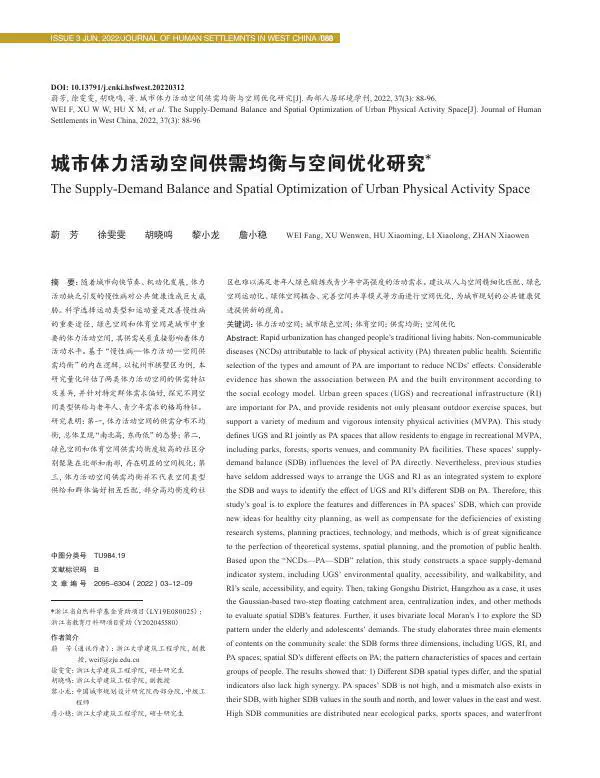
随着城市快节奏、机动化发展,体力活动缺乏引发的慢性病对公共健康构成巨大威胁。科学选择运动类型和运动量是改善慢性病的重要途径,绿色空间和体育空间是城市中重要的体力活动空间,其供需关系直接影响着体力活动水平。基于“慢性病——体力活动——空间供需均衡”的内在逻辑,以杭州市拱墅区为例,本研究量化评估了两类体力活动空间的供需特征及差异,并针对特定群体需求偏好,探究不同空间类型供给与老年人、青少年需求的格局特征。研究表明:第一,体力活动空间的供需分布不均衡,总体呈现“南北高,东西低”的态势;第二,绿色空间和体育空间供需均衡度较高的社区分别聚集在北部和南部,存在明显的空间极化;第三,体力活动空间供需均衡并不代表空间类型供给和群体偏好相互匹配,部分高均衡度的社区也难以满足老年人绿色锻炼或青少年中高强度的活动需求。建议从人与空间精细化匹配、绿色空间运动化、绿体空间耦合、完善空间共享模式等方面进行空间优化,为城市规划的公共健康促进提供新的视角。
Abstract
Rapid urbanization has changed people’s traditional living habits. Non-communicable diseases (NCDs) attributable to lack of physical activity (PA) threaten public health. Scientific selection of the types and amount of PA are important to reduce NCDs’ effects. Considerable evidence has shown the association between PA and the built environment according to the social ecology model. Urban green spaces (UGS) and recreational infrastructure (RI) are important for PA, and provide residents not only pleasant outdoor exercise spaces, but support a variety of medium and vigorous intensity physical activities (MVPA). This study defines UGS and RI jointly as PA spaces that allow residents to engage in recreational MVPA, including parks, forests, sports venues, and community PA facilities. These spaces’ supply-demand balance (SDB) influences the level of PA directly. Nevertheless, previous studies have seldom addressed ways to arrange the UGS and RI as an integrated system to explore the SDB and ways to identify the effect of UGS and RI’s different SDB on PA. Therefore, this study’s goal is to explore the features and differences in PA spaces’ SDB, which can provide new ideas for healthy city planning, as well as compensate for the deficiencies of existing research systems, planning practices, technology, and methods, which is of great significance to the perfection of theoretical systems, spatial planning, and the promotion of public health. Based upon the “NCDs-PA-SDB” relation, this study constructs a space supply-demand indicator system, including UGS’ environmental quality, accessibility, and walkability, and RI’s scale, accessibility, and equity. Then, taking Gongshu District, Hangzhou as a case, it uses the Gaussian-based two-step floating catchment area, centralization index, and other methods to evaluate spatial SDB’s features. Further, it uses bivariate local Moran’s I to explore the SD pattern under the elderly and adolescents’ demands. The study elaborates three main elements of contents on the community scale: the SDB forms three dimensions, including UGS, RI, and PA spaces; spatial SD’s different effects on PA; the pattern characteristics of spaces and certain groups of people. The results showed that: 1) Different SDB spatial types differ, and the spatial indicators also lack high synergy. PA spaces’ SDB is not high, and a mismatch also exists in their SDB, with higher SDB values in the south and north, and lower values in the east and west. High SDB communities are distributed near ecological parks, sports spaces, and waterfront spaces; 2) Spatial polarization exists. Northern communities’ UGS have the highest SDB value, while those in the south have the highest RI value, and 3) Although the supply and demand are balanced, the spaces do not satisfy certain groups of people. The spaces that have typical SDB features have different effects on the elderly or adolescents’ PA level. It is suggested that space optimization should be carried out by matching people and spaces, adding sports facilities in UGS, integrating UGS and RI, and sharing space to provide a new perspective to promote public health in urban planning.
引用格式
@article{2022_xbrjhj_physical_activity_optimization,
  title={城市体力活动空间供需均衡与空间优化研究},
  author={蔚芳 and 徐雯雯 and 胡晓鸣 and 黎小龙 and 詹小稳},
  journal={西部人居环境学刊},
  year={2022},
  doi={10.13791/j.cnki.hsfwest.20220312}
}

蔚芳
浙江大学副教授
现任浙江大学建工学院副教授。先后于同济大学获得城市规划学士与硕士学位,美国弗吉尼亚理工大学获得城市管理与规划博士学位。致力于空间规划与人工智能,气候变化与空间优化等方面的研究。主讲课程包括《国土空间规划理论与方法》、《城市经济学》等。已发表中英文书章及学术论文30余篇,其中学术专著7部,研究成果发表于《Landscape and Urban Planning》《Environment and Planning A》《城市规划》等国内外知名SCI/SSCI/EI期刊。主持国家自然科学基金、浙江省自然科学基金等多项科研项目,以及数十项城乡规划与设计实践项目;同时主持包括浙江大学慕课(MOOC)课程在内的十余项教学改革项目。曾获金钥匙国际荣誉协会终身荣誉会员等多项国际学术荣誉;以及全国城乡建设优秀勘察设计奖、建设部城乡建设优秀勘察设计项目、浙江省及杭州市等优秀城乡规划设计奖、我最喜爱的老师等多项荣誉与奖项。现为多个国际学术组织的会员或终身荣誉会员,担任十余种国际学术期刊的审稿人;并担任包括国家自然科学基金、浙江省自然科学基金等在内的诸多基金项目评审专家。