摘要
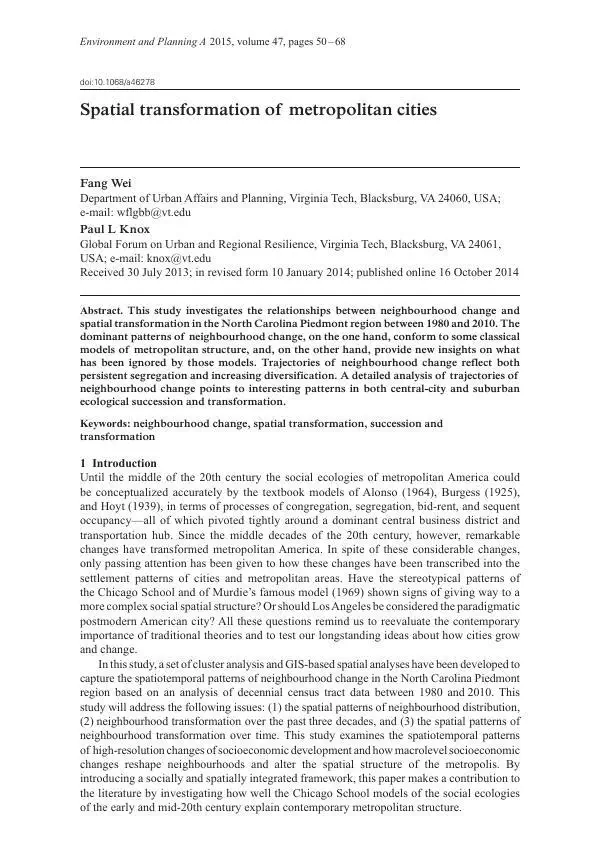
This study investigates the relationships between neighbourhood change and spatial transformation in the North Carolina Piedmont region between 1980 and 2010. The dominant patterns of neighbourhood change, on the one hand, conform to some classical models of metropolitan structure, and, on the other hand, provide new insights on what has been ignored by those models. Trajectories of neighbourhood change reflect both persistent segregation and increasing diversification. A detailed analysis of trajectories of neighbourhood change points to interesting patterns in both central-city and suburban ecological succession and transformation.
摘要
本研究调查了1980年至2010年间北卡罗来纳州皮德蒙特地区社区变化与空间转型之间的关系。社区变化的主导模式一方面符合一些经典的大都市结构模型,另一方面也提供了关于这些模型所忽视的新见解。社区变化的轨迹反映了持续的隔离和日益增长的多样化。对社区变化轨迹的详细分析揭示了中心城市和郊区生态演替和转型中有趣的模式。
Abstract
This study investigates the relationships between neighbourhood change and spatial transformation in the North Carolina Piedmont region between 1980 and 2010. The dominant patterns of neighbourhood change, on the one hand, conform to some classical models of metropolitan structure, and, on the other hand, provide new insights on what has been ignored by those models. Trajectories of neighbourhood change reflect both persistent segregation and increasing diversification. A detailed analysis of trajectories of neighbourhood change points to interesting patterns in both central-city and suburban ecological succession and transformation.
引用格式
@article{2015_epa_spatial_transformation,
  title={Spatial transformation of metropolitan cities},
  author={蔚芳 and Paul L Knox},
  journal={Environment and Planning A 2015, volume 47, pages 50–68},
  year={2014},
  doi={10.1068/a46278}
}

蔚芳
浙江大学副教授
现任浙江大学建工学院副教授。先后于同济大学获得城市规划学士与硕士学位,美国弗吉尼亚理工大学获得城市管理与规划博士学位。致力于空间规划与人工智能,气候变化与空间优化等方面的研究。主讲课程包括《国土空间规划理论与方法》、《城市经济学》等。已发表中英文书章及学术论文30余篇,其中学术专著7部,研究成果发表于《Landscape and Urban Planning》《Environment and Planning A》《城市规划》等国内外知名SCI/SSCI/EI期刊。主持国家自然科学基金、浙江省自然科学基金等多项科研项目,以及数十项城乡规划与设计实践项目;同时主持包括浙江大学慕课(MOOC)课程在内的十余项教学改革项目。曾获金钥匙国际荣誉协会终身荣誉会员等多项国际学术荣誉;以及全国城乡建设优秀勘察设计奖、建设部城乡建设优秀勘察设计项目、浙江省及杭州市等优秀城乡规划设计奖、我最喜爱的老师等多项荣誉与奖项。现为多个国际学术组织的会员或终身荣誉会员,担任十余种国际学术期刊的审稿人;并担任包括国家自然科学基金、浙江省自然科学基金等在内的诸多基金项目评审专家。