摘要
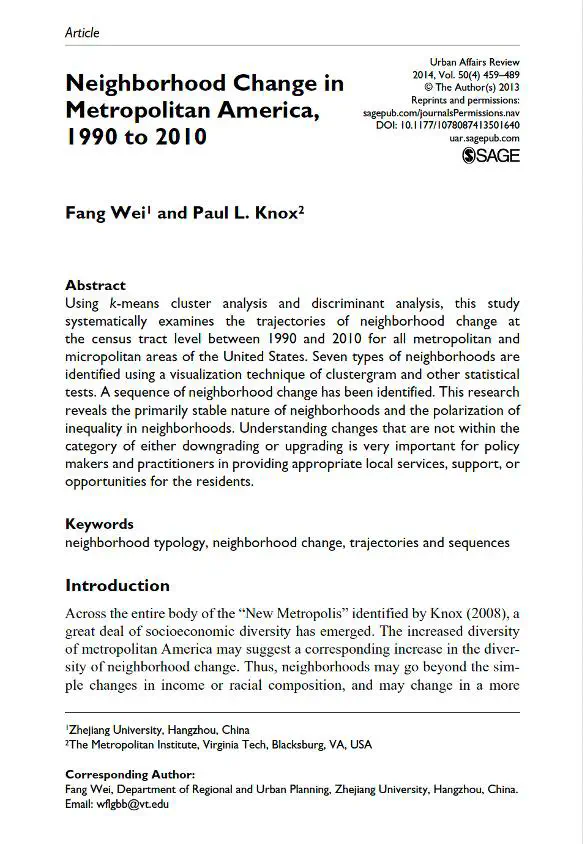
This study systematically examines neighborhood change trajectories at the census tract level across all U.S. metropolitan and micropolitan areas from 1990 to 2010. Using k-means cluster analysis and discriminant analysis, seven distinct neighborhood typologies are identified. The research reveals a primarily stable nature of neighborhoods, alongside a polarization of inequality. It highlights that many significant neighborhood changes do not fit neatly into traditional categories of downgrading or upgrading. Understanding these diverse and complex trajectories is crucial for policymakers and practitioners to effectively provide appropriate local services, support, and opportunities for residents.
摘要
本研究采用k-均值聚类分析和判别分析,系统考察了1990年至2010年美国所有大都市区和微型都市区内邻里变化的轨迹。通过聚类图和其他统计检验,识别出七种邻里类型。研究揭示了邻里性质主要保持稳定,同时伴随着不平等的两极分化。值得注意的是,许多重要的邻里变化并不属于传统的降级或升级范畴。理解这些多样化和复杂的轨迹对于政策制定者和实践者有效提供适当的本地服务、支持和机会至关重要。
Abstract
This study systematically examines neighborhood change trajectories at the census tract level across all U.S. metropolitan and micropolitan areas from 1990 to 2010. Using k-means cluster analysis and discriminant analysis, seven distinct neighborhood typologies are identified. The research reveals a primarily stable nature of neighborhoods, alongside a polarization of inequality. It highlights that many significant neighborhood changes do not fit neatly into traditional categories of downgrading or upgrading. Understanding these diverse and complex trajectories is crucial for policymakers and practitioners to effectively provide appropriate local services, support, and opportunities for residents.
引用格式
@article{2014_uar_neighborhood_change,
  title={Neighborhood Change in Metropolitan America, 1990 to 2010},
  author={蔚芳 and Paul L. Knox},
  journal={Urban Affairs Review},
  year={2014},
  doi={10.1177/1078087413501640}
}

蔚芳
浙江大学副教授
现任浙江大学建工学院副教授。先后于同济大学获得城市规划学士与硕士学位,美国弗吉尼亚理工大学获得城市管理与规划博士学位。致力于空间规划与人工智能,气候变化与空间优化等方面的研究。主讲课程包括《国土空间规划理论与方法》、《城市经济学》等。已发表中英文书章及学术论文30余篇,其中学术专著7部,研究成果发表于《Landscape and Urban Planning》《Environment and Planning A》《城市规划》等国内外知名SCI/SSCI/EI期刊。主持国家自然科学基金、浙江省自然科学基金等多项科研项目,以及数十项城乡规划与设计实践项目;同时主持包括浙江大学慕课(MOOC)课程在内的十余项教学改革项目。曾获金钥匙国际荣誉协会终身荣誉会员等多项国际学术荣誉;以及全国城乡建设优秀勘察设计奖、建设部城乡建设优秀勘察设计项目、浙江省及杭州市等优秀城乡规划设计奖、我最喜爱的老师等多项荣誉与奖项。现为多个国际学术组织的会员或终身荣誉会员,担任十余种国际学术期刊的审稿人;并担任包括国家自然科学基金、浙江省自然科学基金等在内的诸多基金项目评审专家。